Renovation // Transformation

Renovation // Transformation

Finishing Touches

The laundry area/sewing nook is finally finished with the topping of Casie’s new desk. As our friend Wesley puts it, it’s our "proof of concept" for the kitchen cabinetry soon to come.

The desk itself is made entirely from IKEA parts. Unfortunately we needed a cabinet 15in wide X 24in high and 20in deep. IKEA has one which is 15in wide (X 30in high), one which is 24in high (X 36in wide) and nothing 20in deep… however, by purchasing the 15in wide one and the 24in high one, I was able to use the top/bottom from one set and the sides from another and only had to make cuts on the table saw for the depth. And of course, we needed two. Because of the way the pieces join, it was crucial to get some matchy-matchy pieces.

While it generates lots of left over particle board (for a pair of 30X36in cabinets, i s’pose), using stock parts made for an easier construction overall and it matches what will be done in the kitchen. After installing the 6in legs, the desk was the perfect height. And the cabinet now fits her vintage Necchi sewing machine perfectly.

The desk-top caused some concern as the kitchen counters will be Silestone to match the bath, but getting someone to fabricate a relatively small piece (22X63in) at a cost under $1000 was hard to find (and we had a hard time justifying a $1000 desk-top). After hemming and hawing (and returning) several countertop options, I discovered that IKEA had a cabinet door that was the size we needed (24X64) and the perfect thickness (3/4in). A few cuts on the table saw (and a hole) later, it was the perfect fit. Since it will be a sewing table initially (or a home-office nook with data/cable/phone close at hand), we wanted it to be sturdy, so I fabricated an aluminum brace from a stock "L" for the front support (which happened to compliment the IKEA aluminum plinth at the base of the cabinets). We’ll eventually top it with some glass for protection, but there are larger projects still to tackle.

Snc18148Snc18153Snc18149Snc18152Snc18154

Renovation // Transformation

Before and After

Sometimes, it’s easy to get a bit down about the assumed lack of progress — but as I mentioned to a friend recently, with us doing most of the work on a 40 year old house, a little job often turns into a much larger project… you peel back one layer and find 3 other problems (or "opportunities"). So while it might be two steps forward, one step back, it is progress… albeit slow.

But this week, we’ve put the finishing touches on the laundry room (specifically bi-fold doors and cabinetry which will house Casie’s "sewing nook"). Admittedly it is not the most important room in the house, but it did make sense to start here and work back… many of the decisions we dealt with here will be reflected in the upcoming kitchen, plus it was easier to wire with the wall open. We also added some solar shades to the sliding doors to block the afternoon sun which has been effective so far…

And when looking at a few of the "before" images, the "after" ones do instill a slightly greater sense of accomplishment…

Snc14957102_3120102_3119102_3121102_3122102_3115102_3123

Renovation // Transformation

Moving the Machines

Edit: looking back at this post 17 years later, a few things come to mind:

  • I should have used larger photos in the early phase of the blog — sorry. I learned and changed later.
  • This is probably the #1 quality-of-life improvement we've made with the house.
  • This is such a practical edit that I've helped at least four other folks in our neighborhood make the same change.
  • A proper light switch vs. a pull chain on that light would have been a better choice.
  • Trimming out the closet doorway with mahogany like Glen eventually did is a good choice.
  • Installing blocking on the back wall for shelving would have been helpful.
  • Pulling water from the boiler room versus looping it from the original location would have been more efficient.
  • installing a more accessible clean-out and inspection panel would have been useful long(er)-term.
  • I should have deleted the doorway into the space altogether — taking the wall to the ceiling like we did with Chris/Sara's (and probably Laura/Chris').
  • An added electrical outlet on the wall that backs up to the kitchen cabinets would have been handy — and easy considering there's electrical on the opposite side — a fairly easy add-on, but easier pre-drywall.

(from June 2008)

Eichler homes have some decidedly modern characteristics that were novel for the early 60s yet remain practical today — like a master suite, separate family room/den, an open floor plan, etc.

One of the things we like is the "hobby" room or as most folks would call it a laundry or utility room. This brings the washer and dryer into the house (from the garage) which makes for a neater/tidier laundry-chore and in some models, the machines were located near the bedroom areas so as to keep closets, dirty clothes, and machines to wash them in close proximity.

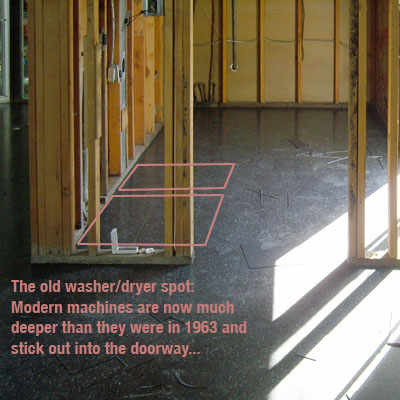
However, in 1963, the trend was for smaller machines as the spaces speced to house the washer and dryer are often fairly shallow. This means that the modern equivalents (in order to fit) are the smaller "apartment sized" washer and dryers which makes it hard to do a load of towels. We had a pair of these in our old condo (upstairs, which was awesome), but we really wanted full-size machines this time.

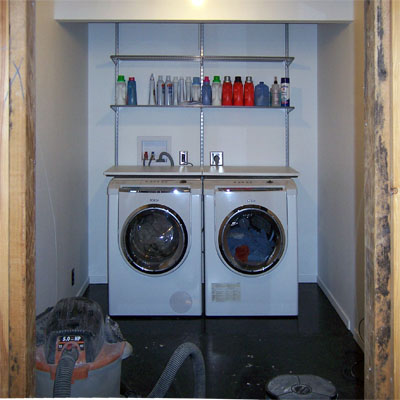
In order for the machines to not block the doorway and to be able to eventually conceal them behind bi-fold doors, we opted to move the machines to the back of the room. While this made for a much more usable space overall, it did present some challenges which involved relocating plumbing and venting which was the focus of a recent 3-day weekend… fun: fire, solder, framing nailers and drywall mud!

Anyway, the machines are now moved, the drywall finished and the space flows much better.

6a00d8345166b769e200e552d47e0c8834-800wi.jpg

6a00d8345166b769e200e552d47e0c8834-800wi.jpg

6a00d8345166b769e200e552d47e0c8834-800wi.jpg

6a00d8345166b769e200e552d47e0c8834-800wi.jpg

6a00d8345166b769e200e552d47e0c8834-800wi.jpg

Renovation // Transformation

What a Difference 36,000BTUs Make

Chris writes:

"So I have to ask…how's the system handling this heat wave? We've got a fan blowing over a bag of ice over here…"

I respond:

"Awesome. I set it at 80deg before I left the house this morning and came home (6ish) to a nice and cool house — I just kicked them down to 74 just because we could. We were worried about the uncooled 1/2 of the house, but it's fine, too… it was over a hundred in Concord today — stepping off the BART train was like stepping into a blast furnace. We're unsure of power consumption, but so far we're VERY happy — without the upgrades in the AC and white foam roof, I'd be sweating in my underwear over here…"

While the back bedrooms are not climate controlled, we found these at big orange last night and I'll be fitting them into the wall — they open to the side yard, so they'll be inconspicuous (and affordable). They have both heat and AC and will run on 120V (rather than many AC/heaters which are 220V). The heat option is what sold me as the radiant heat is dodgy in these 2 rooms.

Renovation // Transformation

Spring Has Sprung

Since we chopped down all of the trees, it only made sense to plant more. In all seriousness, the ones that were there were weed trees that grew out of control. Hopefully, these will be more appropriate.

— a Japanese Maple (Emperor-1) and Dogwood (Cornus Florida) replace the overgrown Oleanders. These stay in the shade of the Pepper tree most of the day, so I think they’ll be happy.
— a Hinoki Cypress replaces the overgrown weird house plant by the door.
— a standard Japanese Maple (green) and a Suminagashi (red) Maple that will hopefully withstand the sun.
— a Japanese Sawtooth Elm (Zelkova Serrata) replaces the Privet and Mock Orange — this variety should grow to about 50 feet and protect the house from the afternoon sun. Eventually, we’ll have to cut down the Mulberry trees that were planted too close to the house and this will replace the shade that the Mulberry’s provide.
— a Variegated Maple replaces the old raised garden bed and will provide some necessary afternoon shade.
— an Autumn Blaze maple in Steve’s yard replaces an overgrown Oleander. Our deal was that I’d plant it if he’d water it.
— a new standard Meyer Lemon in the new garden area.
— finally, a Yoshino/Akebono Cherry in the front lawn…

The Cherry tree was not an easy one to plant. The soil in Concord is very hard clay. I had to rent a jackhammer (really) to get through the soil. But I learned a lesson: Digging holes is no fun.

When I went to pick-up the jackhammer, the guy at the rental shop told me it was easy to use. "Yeah," I replied, "I guess it doesn’t take a Ph.D to operate a jackhammer"… "Well," he said, "the way I figure it, folks get Ph.Ds so that they don’t have to operate jackhammers…". Truer words were never spoken.

Snc17630_2Snc17635Snc17637Snc17631Snc17632Snc17633Snc17629Snc17636

Renovation // Transformation

I Am Rubber Redux

So, we had this rubber tree in the atrium. It was unkempt and grew into the roof. We cut it down. It grew back — it… would… not… die.

It's dead now.

Casie spent a good part of Sunday afternoon making sure of this with the help of a few tools: a chainsaw, sawzall, sledgehammer and pick-axe. It was not pretty, but now it's done… after she pulled the heart of the tree out, she chucked it into the street — it was quite dramatic.

Time for part two… since the tree seemed really happy, but simply unkempt, I thought it right to try again. Besides, the house wouldn't seem the same without it. The previous owner's kids admitted that their mom liked the overgrown look and refused to let anyone trim it — and while I don't mind the naturalistic look myself, we'll be keeping an eye on this one.

I stopped by the local nursery and picked up a small version — and while at big-orange, I spied a larger one. So, one is now in the ground and the other in one of the new Ikea pots we recently picked up.

Edit: Benjamin Franklin defines insanity as doing the same thing over and over and expecting different results. In that sense — what were we thinking planting another rubber tree!? We've since planted a beautiful and slow-growing maple tree in that space and everyone's all the happier. The rubber plants will live in the house in nice containers.

Snc17616Snc17620Snc17618Snc17623Snc17624Snc17625

Renovation // Transformation

What a Difference a Jaime Makes

As I mentioned, Jaime and his crew have been busy… and the work is amazing.

It's looking a bit bare presently, but it was so far overgrown (with years of bad pruning), that we needed to start over. It'll look lots better once the tree sprouts out a bit and we're able to re-plant a bit.

Below are a few before and after pictures… tree removal, landscaping and a massive amount of concrete removal… so, if you're in the market for some landscaping, drop him a line (jzcruz.com) and tell him we sent you. Seriously, he's good.

B1B2C1C3D1D2_2E1E2

Renovation // Transformation

Siding Replacement

This weekend found a major push in finishing off the siding replacement on the west-ish side of the house. We’re replacing windows at the same time, so it’s a multi-step process. We’ve discovered that — when possible, the siding is easier to remove by pounding on the reverse with a sledgehammer rather than prying from the front — who knew? Working from the bottom edges is working best for us.

When our siding was originally hung, they used 2in T-nails which are mainly used for flooring these days. the T-nail is nice as the head sits below the surface of the siding, but in our case, it seemed like they were getting paid by the nail… far too many in my opinion (about 2X too many).

As I mentioned, we’re also replacing the windows along the way which also gives a good opportunity to replace the sill and trim. We’re using redwood when/where possible, especially on the sills which is a pretty simple creation — 4 cuts on the table saw and a jigsaw cut at the edges. It actually takes less time and money to make new sills than to restore (sand/strip/fill) the old ones.

The previous owners cut a window in the garage as they converted it into to bedrooms (a very, very large family). We’ve converted it back into a garage/workshop, but we love the window. Since they cut it in while the house/siding were together, the structure wasn’t quite right for a proper window install (header, supports, etc.). Opening the wall gave us the opportunity to rebuild the structure and reinforce the sill-plate which was a bit loose on the foundation (hello, new hammer drill!).

Oddly enough, the beams in this area do not actually run the length of the house and in this area, there was no beam over the window area. Since all the other windows were installed beneath beams, we wanted to recreate the effect (and structural integrity). With two 2X6s sistered together for the structural part, we installed the reinforcement. When we lifted the beam in place, you could hear a bit of a creak, indicating that it was indeed taking a bit of load. On the face, however, we had to get a bit more creative with the "beam effect" to make it look like the others. We opted to face the area with some exterior/marine plywood the width of the original beams. These will eventually be painted the same color and I doubt you’d be able to tell the difference.

The project also allowed the insulation and drywalling of the garage. While a bit excessive, I’m spending quite a bit of time in there as of late and the insulation and clean walls will be nice later on.

Lighting was also an added element… a replacement fixture by the sliding door a new one by the garage window. While the switch for this new one will be adjacent to the inside garage window, it’ll be nice to simply have some light up there as it gets pretty dim — and with the wall open and lots of new electrical circuits in there (2 new 20amp circuits), the wiring was a snap. All fixtures from Progress lighting which we’ve installed around the house to replace the older, Early-American-style fixtures (and temporary $2 plastic ones).

Something that wasn’t as available 45 years ago was the variety of caulks, glues and insulation… The original windows were installed with almost no caulk or weatherproofing. We’re using a generous amount of the latest stuff and far too many cans of spray foam.

Snc17098Snc17102Snc17100Snc17104Snc17105Snc17106Snc17101Snc17102_2Snc17108

Renovation // Transformation

Shelf Wall (better explained)

After seeing a post on Apartment Therapy (Casie is still giggling about that one), Michele wrote to ask some more specifics about the construction of the wall and how the paneling works with the shelf standards. Here goes:

When installing the wall, we created a flush surface by blocking out the wall (we ended up going all the way to the floor and ceiling in the end). We could have simply put a layer of plywood over the studs, but believe it or not, we couldn’t afford the extra 3/4in depth as we didn’t want the desk to hang out past the sliding door frame to it’s left. In most cases, 3/4in plywood could be mounted directly to the studs rather than inset — I’d be afraid 1/2in plywood would not be thick enough to prevent screw pull-out on the standards once weighted with shelves, books, etc.

Anyway, after creating a solid/sturdy mounting surface (which we needed as the shelf standards would not be mounted directly to studs because of spacing — and after 40 years the studs are not square anyway), we cut 21in strips of 3/8in sheetrock (avoiding the beveled side) and 1/4in paneling — the 21in measurement came from the length of the wall divided by the number of standards (we wanted even spacing along the wall).

The Rakks brackets have a 5/8in backspacing (for 5/8in drywall), so the doubled-up drywall and paneling was the perfect thickness (see image below). The brackets also have about 1/8in slop on either side, too… just in case. After some (very) careful measurements, we secured the drywall to the plywood blocking with screws as you normally would.

We inlaid the paneling on top of the drywall with only a few brad nails at the very top to allow for expansion then simply laid the shelf standards over the pre-measured gap and screwed them to the blocking that was revealed by the gap we allowed. The flanges of the standards holds the paneling to the drywall (you could also use a few dabs of construction adhesive to bond the paneling to the drywall — but for us, shifting is not a problem as the panels go floor to ceiling and wall to wall, so they’re tight).

All in all, a very easy project effort-wise, but a bit of a brain-twister to plan out. It was a bit tough to cut 10-foot stock (the height of the wall) — for which i had to make a cutting jig/template to floor-cut the straight cuts with my skillsaw (as I didn’t trust feeding such a long piece through the table-saw)… a true panel-saw would have been nice here. Hopefully these go-bys help folks. If you have more questions, please feel free to email.

BracketDg1Dg2

Scroll to Top