Today, the heat will remind much of the Bay Area what summer really feels like — it'll hit near 100 today in Concord… so this post seems appropriate.
I spent the morning talking to neighbors about various options for this-and-that and one of them was air conditioning. Matt's comment was: "Well, we can't really afford air conditioning, so we're thinking about getting a swamp cooler".
I said: "Wait, maybe you can have AC and not spend a bundle…" and I told him of how we added two units to the back of our own house (14K-BTU total) for under $1000… and that — thinking a bit larger — it'd not be impossible to add 24K-BTU to their main living space for about the same cost.
Here's how: window units… plumbed into the wall (or through the wall units). You could even use a casement model and not have to do as much re-framing.
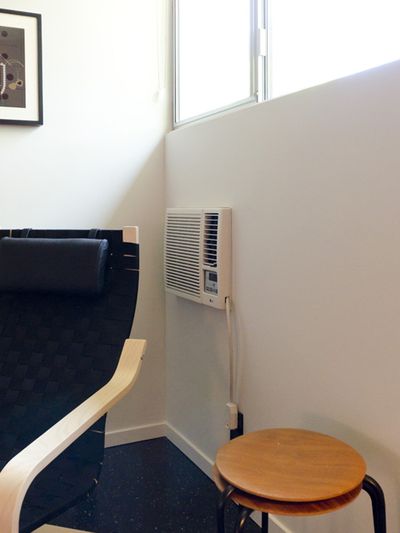
In our case, it took some extra bracing and what-not to support the unit and seal the wall, but it was a day's work soup-to-nuts. Not bad. We used 7K-BTU LG units.
Granted, it's not always the most aesthetically pleasing solution, but it's not terrible either (nor bank-breaking) — and, for us, these units face the garden where there are other services (hoses, irrigation, etc), so it's not out of place. And, depending on how you trim them out on the inside and outside, they can look near-seamless… or at least not as ghetto. You can now find some units that are really well designed… well, for an AC-unit.
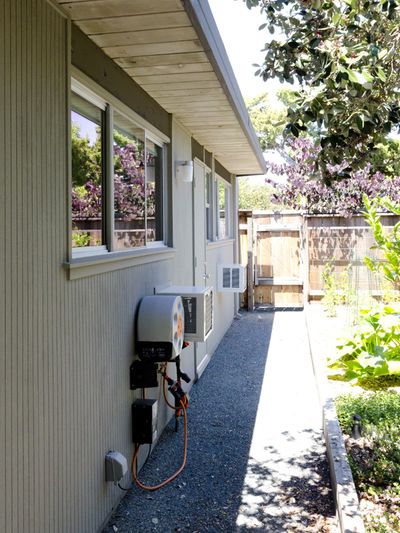
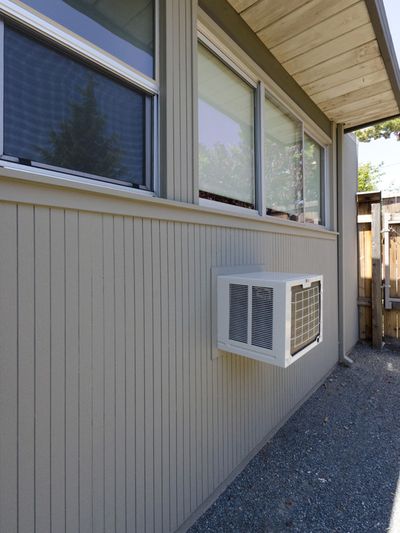
In Matt's case, their dining room wall backed up to a similar service yard and the wall is a prime candidate for a wall-unit of shelves which could be constructed to hide the unit when not in use (think sliding doors on an Eames Storage Unit). Adding a 24K-BTU unit to this wall (or a pair of 13K though-the-wall units) would mean running a 220 electical line to the area, but a swamp cooler would need similar electrical requirements… and turn your house into a swamp with the added humidity.
If you were to add such a thing, the process is pretty simple.
- First, locate a good spot near existing electrical or where you'll run new electrical. Remember, if using existing electrical, make sure the circuit can handle it as ACs are big-draw items. Also, think about flow — we placed ours where they can blow into the hallway creating a better flow.
- Size the unit correctly. While it's generally better to have a bigger unit than necessary, if you're using existing electrical, the lower the amp-draw, the better. If you're running new 220V circuits, go big or go home! Generally 6-8K units are good for bedrooms and 12-18K are good for larger spaces and 24K would be good for a combo of rooms (living room/dining room for instance).
- Many of these have heating functions. While inefficient, it's nice to have the option for a quick re-heat to take the chill off of a room before the radiant heat has a chance to take over.
- When venting to the outside, make sure it's venting to a clear area that's out of the way. Don't vent to a garage or atrium as the trapped heat will likely migrate back into the adjacent space.
- When you've IDed the prefect spot, size the hole correctly and draw on the interior wall.
- Get a long, thin drill bit (6in at least). 1/8in is plenty big as you're just making markers.
- Angle the drill slightly toward the ground — maybe 3deg. you should have a slight pitch backward to allow water condensate to easily drain from the back of the unit. Drill through the drywall and the siding at all four corners. Double check your measurements, but you now have your marks. Connect the dots and cut facing holes in your drywall and siding. A circular saw blade set to 1/2in works well for this.
- You might have to remove a good bit of drywall on the inside to do it right. No worries — you can always re-drywall which gives you the option of making a very cleanly finished install.
- Chances are, you'll need to chop through one stud (and one stud only) if the AC is wider than 14.5in (most are). Because of the post/beam construction, the idea of a "load bearing wall" is different in an Eichler, but you'll still want to reinforce the area. To re-displace the load you'll need to install a header beam (doubled up 2X4s) — and jack-studs or hangers — to carry the weight. You'll also need to create a sill plate for the unit to rest on. The top plate is the header itself. Side bracing is optional, but not a bad idea. You might need to cut away more drywall to expose the working area here. If none of this makes sense, you might be best to hire this part out. You can't just rest the AC on the unreinforced drywall edge — it must have a structural support. Messing up installation could mean condensate dripping into the wall which will bring on dry rot of the entire area — not good.
- (Note: If You happen to chose a casment style model, there's a good chance it would fit between the studs with no re-construction. You'd still need a sill and a top plate, but it'd be much easier to install.)
- On the sill plate, make sure to weatherproof this with flashing or Bituthene. Wrap the self-stick waterproof membrane the length of the sill plate, plus up the side an inch or so. Be safe and wrap some around the outside edge, too. You want this area to be as waterproof as possible
- Install your unit and secure to the new structural support. Each unit is different, so pay attention to the design of the unit when buying to ensure there are no vents in the area that — in your case — will be within the wall. The LG units were fine. Many "through the wall" units are designed to be completely enclosed within a (very thick) wall using a "sleeve". In the case of our walls, they're only 4.5in thick and most "window" units I've seen could work well.
- Caulk well around the outside edges with a silicone or polyurethane caulk. I like Skiaflex 1A as it's paintable.
- Trim the outside edges like a picture frame, prime and paint.
- Trim around the interior with wood or drywall/drywall edging.
Anyway… if you're sweltering today, know there are options. Hopefully, we'll get a neighbor who wants to tackle this so we can update with in-process pictures (as I didn't take any when we were doing ours).