Many thanks to West Elm for their feature of this site and the project itself. It's always nice to see folks outside of the immediate Eichler community taking an interest in the things we wax on (and wax off) about here on RedneckModern.
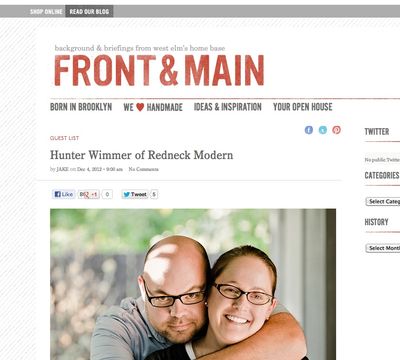
Jake, the editor over at Front + Main did a great job summarizing the interview… as you can imagine the entire bit was longer. I've included the entirety of it below. Also make sure to check out Front & Main itself as well as West Elm's new Market — they're doing some good things at both.
1. Were you an Eichler fan before you bought your house? What quality was it that drew you to the space, even in its original state of disrepair?
Yes, sort of… we were fans of Eichler homes without too much familiarity with the houses themselves. We've always been drawn to modern architecture and have some friends that have lived in Eichler-built homes — but living in San Francisco (the city), the idea of a bucolic inside/outside modern experience always seemed a bit out of reach monetarily. Of course, the overall style of the homes is quite common in media — we will now often "Eichler-spot" while watching TV commercials — and it's something that we've been drawn to visually and conceptually.
When we first looked at our current house, we were living in West Oakland in an amazing David Baker-designed townhouse — we loved it. However, the location was terrible and outside of our small enclave, there was not a lot of common ground within the neighborhood. After a series of unfortunate incidents — for instance, a stolen, runaway van full of porno smashing into our house on Christmas night — we knew it was time to leave.
We had just visited Palm Springs for a bit of an urban-blight-palette-cleanser and thought: "Wouldn't it be great to find something in the Bay Area that captured this ethos?". The day we returned, I happened to search Craigslist for "Eichler" and one popped up as a foreclosure in Concord. We didn't know there were Eichlers outside of Marin and the South Bay and my wife went for a drive-by after work. She was amazed to find not only a house, but an entire neighborhood. In the end, we discovered that there are three Eichler neighborhoods in Concord, and two-and-a-half in Walnut Creek… and ones that we could afford. Concord Eichlers range now in the mid-$300s to low-$400s and even at the height of the market barely crested $600k.
We missed the opportunity to bid on that house, but we quickly got our proverbial ducks in a row for the next opportunity. When we first visited our current home, we initially came out to look at a house on the next street — now inhabited by our friends Kyle and Sarah. There were some things that had been "improved" upon with that house that were not to our liking, but our current house had a lockbox on the door and a "coming soon" sign in the yard. We persuaded the agent to let us in. Since it was in /such/ disrepair, we guess he thought it a good opportunity to showcase the move-in-readiness of his own listing, however, when my wife walked into the overgrown atrium, her face lit up in a way I'll never forget. She mouthed "It's perfect!". Considering the work that needed to be done, this was quite a bit of insight — fortunately, it worked out to be the case.
That afternoon, we chased down the listing agent at different open house in Walnut Creek. She greeted us warmly and asked if we were interested. We said, "No, but we want to buy the house on Phoenix." This caught her off guard, but over the next few weeks, we worked out a deal and the wheels were in motion. Ironically, the Walnut Creek house was purchased by our old friends Darren and Leah who were (1) old friends from the East Coast, (2) happenstance neighbors in West Oakland in the same complex and (3) co-workers at the same company… it's funny how fate works even when you don't compare notes beforehand.
Looking back, the thing that drew us to our current space was its originality — and its affordability. Although it had a decade of deferred maintenance, all of the important bits were still there: the globe lights, the original aluminum sliders, the large windows. The house had no working kitchen and the floor had been stripped back to the gooey mastic on the floors, but these were things that were all fixable — and in some cases for the best. Had it had an original, working kitchen, we'd have felt guilty about ripping it out, but the bad 70s replacement kitchen was ripped out the weekend we moved in when we had a "demo party" in lieu of a housewarming party.
Little did we know, we'd live without a functioning kitchen for the next 18-months.
2. Eichler houses are so immediately recognizable as belonging to a very specific mid-century modern design era. Now that we’re in a new century and you’re living in an Eichler, have you found this design to be enduringly relevant or irrelevant in any striking ways?
I remember a student once commenting that she didn't like "Mid Century design" and my response was: "You don't necessarily have to like it, but you should at least respect it." These designers were looking at all design — interior-design, architecture, communication-design, industrial-design — in a whole new way… forever changing the game. Eichler's architects were part of a movement that sought to change the way we looked at living within a space. By reversing the front-facing elements and focusing on the interior and back-yard space, they created a sort of personal haven that was very unique to the era of "front porch" living. Like in all design disciplines, the true icons stand the test of time.
When we look back at the designs that we remember — the ones in museum collections and that we continually reference generation after generation — it's these game changing designs that we point to. The most common example is the iPod. It wasn't just a music player — we already had plenty of those, including the MiniDisc… and we already had the parts and pieces: hard drives, digital music files, etc.. However the iPod changed the way we store, play, share and buy music by looking at these elements in a new way. It wasn't as much a neat device as it was a revolution in the industry.
It may be a tired comparison, but Eichler-built houses are a lot like that. Modern houses existed before the Eichler developments took hold. The Case Study architects saw to that. But few — outside of the small communities in Palm Springs — were built and marketed at such a scale and aimed at a much more broad audience. Joseph Eichler found a way to combine demand (the post-war era was in much need of housing), new materials, new structural techniques and a mass-market business model to bring these designs to a more mainstream audience.
Of course, a house that's 50 years old does need some updating. We are lucky to have a house built in the early 60s as building codes changed to reflect things that are common today — grounded Romex (electrical) and insulation were standard in our house, which made some updates quite easy. To make it a bit more "modern", we've added a mini-split AC/heater to compliment the working, but slow radiant heat; modern data wiring in each room; solar safety film on the windows, a foam roof; an on-demand hot-water heater and a few other bits, but many of the elements remain very similar to the original. We replaced the flooring with modern VCT tile — a sibling to the original VAT tile ("A" standing for asbestos); the kitchen is in the exact same layout and dimension; the new windows are modern low-E aluminum-framed windows strikingly similar to the originals… all in all, we've tried to stay close to the spirit of the house.
3. It seems like there’s a pretty intense online community of Eichler home owners / photographers / message board enthusiasts. How far does that rabbit hole go, and do you participate at all?
(1) Yes… (2) not as deep as you'd think, and (3) yes… although the last bit is sort of by accident. We never intended to be "bloggers" at the start, it was simply a way to catalog the changes that were taking place and broadcast it to friends and family. I'm guessing lots of blogs start out that way.
Eichler owners are no different than Bengal cat owners, Karmann Ghia drivers, or Packers fans living in Chicago. While there we a lot of Eichler homes built, the total number is just a bit over 11,000 homes… which is a drop in the bucket when you consider the amount of houses in general, so there's a bit of "strength in numbers" mentality when working to keep the community vibrant, especially when certain elements of our homes are unique and hard-to-find should you want to replace or update them. With common floor plans and construction techniques, what worked well in one house will very likely work well in another, so comparing notes is essential.
While there's an eponymous network of owners supported by the Eichler Network (www.eichlernetwork.com) and CAModern magazine, there are also other active groups such as lottaliving.com and showcases like www.remodelista.com and www.retrorenovation.com. … There's value in all of these if for no other reason that they help to connect people in different ways. Of course the internet has helped this tenfold and the connections we make online sometimes boil over into everyday life. For instance, when at an open house, you might strike up a conversation with someone in person only quickly to discover that they're "Live2RideTahoe", "Danix"… or in my case "RedeckModern".
Oddly, my own handle has evolved a reach of its own. I remember talking to someone at a professional event who was remarking that they had just bought an Eichler in Castro Valley. Five minutes into the conversation, I had mentioned that I had actually been in the house and photographed it for my blog… "What, wait… /you're/ RedneckModern!?". At that point, he called his wife to tell her the news that he was chatting with me: "Honey, you'll never guess who I'm talking to… RedneckModern!". It was actually a bit awkward, but in the end, it allowed him to get copies of high-res "before" photos of his house and we made a connection (Hi, Calvin!)… This sort of thing has happened a few times and each time, i find it inspiring and humbling.
4. Did you have any background in home renovation when you first started this project, or did you just jump in out of necessity?
I truly think that people who are handy have a gene dedicated to the cause that is activated but is otherwise either not present or dormant in all humans. Home renovation is a lot like car repair, computer diagnostics or cooking in that there's some research and technique involved outside of the labor itself — and you can either do it or you can't. In my case, that gene is active and has been most of my life. When looking at door jambs or plumbing, there's just something that seems to make sense in the same way a Chinese doctor can look at your eyes and tell you that you need to stop eating wheat.
That's not to say that we haven't made a lot of mistakes along the way. Fortunately, these foibles have been minor and nothing's blown up. The mantra "measure twice, cut once" is definitely a handy one to keep in mind when tackling something like this. We had also been tackling smaller project in prior residences and I watched my father renovate his own house many summers in a row. You can also learn a lot by watching PBS, HGTV and DIYnetwork… if nothing else, what /not/ to do. Mike Holmes is my hero.
I've also been fortunate to have been able to work with a lot of talented contractors to tackle the stuff that requires permits or specialty knowledge. These folks are invaluable in a renovation project and one nice thing about the blog is that I get to feature their work and promote their services in a very honest way. Anderson Radiant Heating tops that list along with Abril roofing. I'd trust Glen at Anderson with a key to my house and a signed blank check. There's not a lot of folks out there like that and we've been lucky to have found them.
It also helps that I consider fixing things fun.
5. I’m curious how much you think your knowledge of graphic design informs the way you re-designed the interior of your house? Were there any particular principles that guided that process?
Design principles of balance, harmony, contrast and hierarchy are present across disciplines. I even use cooking as an analogy to my students in class — for instance, you'd never have chicken and turkey and ham for dinner, so why would you use all three of the same type of elements on a page… or in a house? Thinking of it in this way is useful in picking typefaces as well as picking colors or materials.
One of my old instructors, John Malinoski, used to joke: "I'm a designer — I line stuff up." The idea of lining stuff up — either conceptually or physically — is something that has helped in a house with so many angles and corners. When it comes to a lot of the decisions, we look back to the original design ethos for inspiration — specifically at the structure that's already there. I often ask myself: What would the original architect do if they needed to make this modification? How would this seam join to that plane?
6. If you had to each give just two cardinal rules / advice for renovating your own home, what would they be?
(1) Always use the right tool for the job — even if that's a telephone and a checkbook.
(2) Always read the instructions… but don't be a slave to them.
7. Looking back, is there a particular Redneck Modern post or project that you’re each particularly proud or fond of?
I really like our kitchen. While it's a fairly ubiquitous design (it's Ikea after all), I'm proud of the way we took our time; measured and designed with laser-tight accuracy; and the overall construction. There are 53 ways to mess up the assembly of an Ikea kitchen, but I think that looking at it from the POV of a carpenter or craftsman helped quite a bit. I made a lot of subtle modifications that the typical installation doesn't have… all of which added up to more of the sum of the parts. For instance the spacers between the upper cabinets and the wall aren't the "spacers" that Ikea sells, but cut down door panels. This way, the plane of the cabinet face — from door to trim — is consistent in material, color and dimension. We also glued /and/ screwed the cabinet frames together and we took an extra bit of time reinforcing the structure for a rock-solid build. In the end, I'm also a huge fan of the price tag. We spent less that $5K on cabinetry which included Casie's adjacent desk, $2K on countertops, and $8K on appliances and fixtures for a total cost of well under $20K even when you add in the flooring, paint, and other foundational work involved. I think the kitchen feels like a far more expensive project than it actually was and it works very, very well
. However, the love for the finished product does not including the 18-months of cooking on a hot plate. The reason for that is because of the "layered" nature of the house. Without trim to cover this or hide that, we needed to do the walls before the cabinets… and the window before the walls… and the siding and sill plates before the windows… so it took a while.
Casie is a fan of the office. In that room, we retained a bit of the luan elements that we removed from the main living area (the luan plus the wooden cabinets would have been too much) plus worked with an existing off-the-shelf shelving solution from Rakks to create a space with a very custom feel. The way the light streams into the room in the afternoon through the maple tree is quite nice. Casie might also be a fan of the maple tree as it took quite a bit of effort to get the previous resident — an Indian rubber tree — out of the space.
Lastly, please let me know any additional websites / social media channels / whatever that you'd like us to plug for you!
I've tried to plug a few of these along the way in the links above, so it might be a good opportunity to thank a lot of the people who've really helped us along the way in one way or the other (many of whom are linked in the "Friends and Us" sidebar on the site. These are in no particular order: Brad, Kerensa, Amy, Brian, Chad, Sandie, Sara, Don, Hope, Heather, Stephen, Katrine, Dan, Kip, Tim, Christopher, Phil, Diego, Joel, Bret, Kyle, Chris, Greg, Jeff, Glen, Laura, Diane, Mary-Peyton, Hiro, Erin, Sara G., Sarah, Rick, Ron, Richard, Jaime, Max, Clemente, Rogelio, Eduardo, and Marty.
Man, I'm sure I forgot someone… (sorry!)
• If you hit the "Links" sidebar on the blog, there are also quite a few things we've found inspirational.
• You can find me blogging at my day job at www.room557.com
• For what it's worth, you can also now find RedneckModern on Facebook and Pinterest.